For 39 Years I Knew Every Medication by Heart. Then I Blanked on My Own Neighbor’s Name — Until a 12-Minute Sound Brought It Back.
I spent nearly four decades behind a pharmacy counter, recalling drug names, doses and interactions without a second thought. So when my own memory started slipping in retirement, I paid attention — and a chance remark about sound sent me somewhere I never expected.

For thirty-nine years I could stand at a pharmacy counter and pull a drug name, its dose and its interactions from memory faster than I could type them. Recall was the tool I trusted most. So the afternoon I stood in my own kitchen and could not summon the name of the neighbor I’d known for twenty years, I felt something close to dread.
It had been creeping in for a while. A name gone the instant I reached for it. Walking into a room and forgetting the reason. That dull, underwater feeling by mid-afternoon that no second cup of coffee ever seemed to lift. I told myself it was simply what happens after sixty. Everyone said so.
But I had spent my whole career catching the small error everyone else missed — a wrong dose, a dangerous pairing — and this did not feel like “just age.” It felt like a symptom I was trained to take seriously.
My son is a PhD student in neuroscience, and over dinner that spring I finally said it out loud: I’d been losing names. Words. Whole threads of thought. For months.
He didn’t look alarmed. He looked curious. “Have you ever heard of BDNF?” he asked.
He explained it the way you’d explain it to someone who’d spent a career reading package inserts. BDNF — Brain-Derived Neurotrophic Factor — is a molecule some neuroscientists call “fertilizer for the brain.” It helps brain cells communicate and supports the everyday work of learning, focus, and memory. And its levels, he said, tend to drift lower as we age.
“So what raises it?” I asked.
“Movement. Sleep. And — here’s the part you’ll like — there’s research suggesting a specific brainwave rhythm may help encourage it. A frequency. Gamma waves.”
I did what any retired pharmacist with time on her hands does: I read the literature, and I checked the citations. What surprised me was how mainstream it all was. Researchers have studied how the brain settles into different rhythms — slow waves for deep sleep, faster ones for focus — for decades. Gamma waves are among the fastest, and they tend to appear when the mind is sharp, engaged, and connecting one idea to the next.
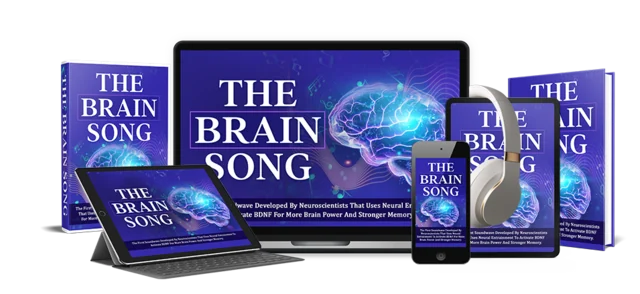
That’s when my son mentioned that a team of neuroscientists and sound engineers had turned this very principle into something anyone could use at home. No clinic. No prescription. A 12-minute audio track, engineered to gently guide the brain toward those gamma frequencies using layered patterns of sound. They call it The Brain Song.
Naturally I was skeptical — skepticism was half my job. But the reasoning held up, and there was nothing to swallow, nothing to remember to take, no interactions to check. Just press play, put on headphones, and listen.
Here is what finally made it click for me. Picture two identical tuning forks: strike one near the other, and the second begins to hum at the very same pitch. It has no choice — it simply falls into step. Your brain does something loosely similar with rhythm: presented with a steady, well-built pattern of sound, its own electrical activity tends to drift toward that pattern. Researchers call it entrainment.
I started on a Monday, with my morning coffee, twelve minutes and a decent pair of headphones. I kept notes — thirty-nine years of logging prescriptions is a hard habit to break.
Pleasant. Quieter in my head than I expected — as if a background hum I’d stopped noticing had been turned down. Too soon to call it anything. Wrote it down anyway.
My afternoons feel longer. That three-o’clock fog didn’t roll in the way it usually does. Could be the weather. Could be me. Still, I noticed — noticing was always my job.
Ran into that same neighbor at the market and her name arrived the instant I saw her — first time in months. My daughter said I sounded quicker on the phone. I hadn’t told her I’d changed a thing.
I’m careful about what I claim — old habit. I’m a pharmacist, not a neuroscientist, and three weeks is three weeks. But I feel clearer than I have in a long while, the routine costs me twelve quiet minutes a day, and I have no intention of stopping.